Click, cringe; click, cringe; click; cringe. I found myself dancing to this most uncomfortable rhythm this past week as I scrolled through a folder of old photos. I’ve never loved having my picture taken, and except for the year 2021 you might look through my iPhotos history and wonder if there was even a human attached to the account. There’s flowers, sky, interesting shadows, but rarely Jennifer. It’s not that I dislike my appearance; it’s fine. The problem is that I rarely truly *see* myself in a photograph. I don’t walk around thinking about my face or limbs or hair (though I probably should think a little more about those things…); I’ve never been self-conscious standing in front of a crowd to teach or speak, because I assume they’re more focused on the information I’m sharing or my general presence. Seeing myself in a photo often elicits a shock of non-recognition. Is that me? Then, where’s the rest of me?
Despite our self-obsessed culture, very few of us have a palpable connection to our bodies. In addition to ways we’re able to radically manipulate our images online, we’ve all, I’m sure, had cringe moments around self-recognition. Hearing your voice on a recording; pulling back from touching your own skin during your first abhyanga, shocked to feel, with your hands, your physical edges; waking up with a sour film on your tongue and teeth when you’re sick; grimacing at the odor when you peel off your shirt after a sweaty workout. So many social norms, and capitalist schemes, exploit this discomfort in sensing the container for our existence, and making us believe we can live our lives without engaging with our bodies.
I’m not advocating for an identification with the body—that would be a crime worth reporting to the Yoga Police. But there’s a line between identification and recognition. We can tend to the body’s needs, adorn it and take pleasure in it, without clinging or limiting ourselves to what happens inside our skin, muscles, fascia, bone, organs, nerves, and mind. This is the line yoga and Ayurveda ask us to walk, skillfully and attentively, as the practice of life.
*
It’s also the precise line of inquiry that our seasonal moment—the autumn equinox, another volta in the sonnet of the year—presents for our engagement. Six months ago, we arrived at the same external moment of “balance” between light and dark, but the internal experience is quite different. In spring, we’re lightening, warming, growing; when the temperature reads 60 degrees, we pull out our shorts and sandals. In autumn, we’re darkening, cooling, receding; as has been the case this week (thanks for the perfect lesson, Nature!), 60 degrees draws out sweaters, socks, and long pants.
Spring’s sight is about growing into our potential; autumn’s sight is about seeing the potential itself, the energy that sprung forth into matter and what still “matters” even as that five-elemental stuff falls away. Spring and fall are both verbs, seasons we transition into and experience as transition itself. But whereas spring is an imperative, fall is a gerund. The difference between a will to “be something” and an allowance that “being” a non-something has been happening all along.
In Ayurveda, we approach the arrival of autumn like all transitions: in stages. While Starbucks wants us to be ready for pumpkin lattes in August (because: money), even though we’re still sticky and sweaty, Nature invites us to cool down and open up; to release heat before we invite in the cozy fall vibes of warmth and heaviness. In TCM, it’s described as a simultaneity—yin inside the yang. Heat and activity—the trademark frenzy of back-to-school followed by the holidays—is there, but our practices orient us to the stability, nourishment, and cool hydration to which the season will ultimately yield. They train our sight to seek and recognize the yin inside the yang of our active lives.
What do we see with these kinds of eyes? Not the solid shapes of our bodies; nor the colors and textures and scents of our clothes and hair and makeup; nor the solid “foods” that nourish all our tissues and senses. It’s the energy that follows from the act of nourishment. It’s how we move in the world, and how we hold onto faith in spring’s light through the darkening half of the year. With this sight, we “see right through” the clutter and facades to the heart of the matter, which isn’t matter at all. To the steady light that shines without needing to be seen. This light is fueled by prana, the rhythmic flow that keeps the heart of our spiral reality expanding and contracting.
“Inner eye” work, if we’re talking about it in a true subtle body anatomy sense, is a bit too abstract even for me to teach. And frankly, I don’t think it’s something we can “achieve” directly through physical practice; it’s more the result of tending our digestive fire, agni, with repeated attention, nourishing it according to its longings. So that’s what we’ll do on the mat this season, from now until the end of October. Moving from branches to roots, from top to bottom, from space to earth, we’ll systematically clear the obstacles to our inner sight so we can recognize our Selves dwelling in a state of Yoga: an expression of integration and good space.
How we take that out into the material world isn’t about dressing for a part. It’s about the impression your presence leaves behind, helping others recognize themselves in the state of Yoga. It’s the shadow that elongates in the wake of someone walking away, of summer retreating into autumn—a seeming loss, but a proof of an existence that doesn’t need daylight to be felt.
*
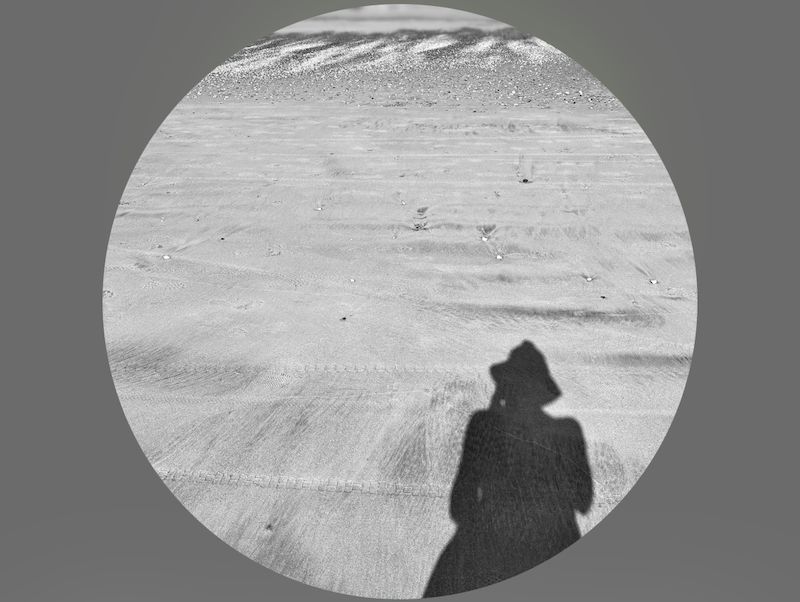
I was halfway through my photo folder when the cringe turned into worry: would I never find a useable shot? All week, I’d been lit up by a new approach to my Ayurveda offerings; after years of trying to “be a practitioner,” but getting inconsistent results, I was on the verge of quitting. Until I saw, on the other side of surrender, what was working, and had always been: an approach that was true to my own healing experience with this profound and endlessly adaptable science. Naturally, the words to describe the “rebrand” came easily, a current of prana flowing so fast and strong I had to effort to keep up. But whenever I thought of the next step—representing this visually on my website—I clenched up and literally held my breath. That’s how I found myself clicking and cringing my way through my Google Drive, anticipating that, again, my insight couldn’t—didn’t deserve to—be seen.
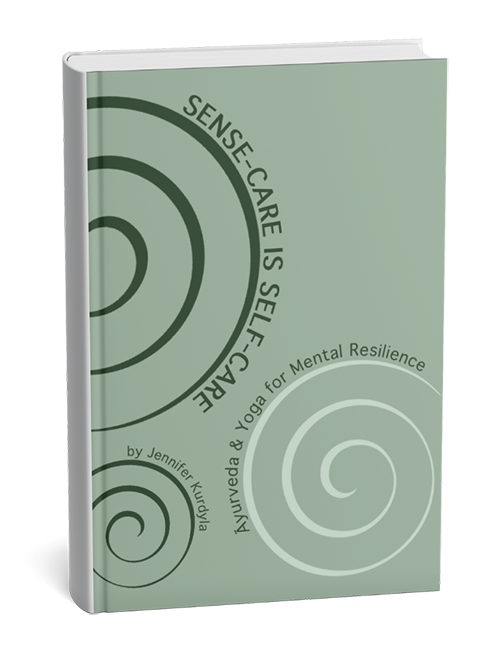
And then suddenly, like autumn itself, it was there. I was there. My body, yes, but also the “rest of me” I knew was there but couldn’t yet see. The photo didn’t show a perfect “pose,” but rather a feeling captured by light—an in-between that no one could have pre-arranged. I immediately thought of what Chrissy Carter, my longtime yoga teacher, said about sight in my book:
Through relationships, we gain a sensitivity in our self-sight that allows for growth. I’ll see that a student has arrived in this place of trust in their skin. There’s a softness that tells me if that person is integrating the movement. The skin acts like a breathable fabric, as opposed to a dense, thick, constricting fabric that shows in the muscle tone. It’s cliche, but they look “comfortable in their skin”—and that’s yoga.
Sharing this with you doesn’t feel nearly as scary as I expected. It’s vulnerable and true, the obvious result of my own ongoing practice that doesn’t feel an ounce like “work” to offer. And while I hope that you click through and are intrigued enough to want to work together, I also hope that you see through the design elements and descriptions to your own Self—what you need to be Yoga, even if it’s not with me. I’ll keep the light on.