Morphosis (noun)
1: the mode of development of an organism or one of its parts
2: a nonadaptive structural modification
-morphosis (noun combining form)
1: development or change of form of a (specified) thing
cytomorphosis
2: development or change of form in a (specified) manner
heteromorphosis
I didn’t have high expectations as I walked through the mesh curtains, held shut tightly by a row of magnets. The girl, in a cropped tee-shirt and braids, who had processed our tickets warned us in the entryway to move through the curtains, and the next layer of plastic door strips that hung like noodles being steamed for lasagna, as quickly as possible. “It’s easy to walk out with a stowaway and not even know it,” she explained with a giggle. I took in the instructions lightly, wondering how many times a day she said that same thing to tourists like us, ready to be, at best, underwhelmed, or, at worst, offended by oppressive, zoo-like conditions on this “Butterfly Farm”—the only real “excursion” we had planned on my family’s mini-spring-break trip to the Caribbean.
I didn’t have high expectations as I arrived on the island 48 hours prior, either. While I knew the overall experience—the beach, the palm trees, the warm weather, the break from work—would be enjoyable, I had been sorting and folding such heavy emotional baggage about why the trip wasn’t really “for me” in the preceding weeks that, if they were actual items in my luggage, I’d for sure have to pay a surcharge. At the core of my inner conflict was something I think a lot of us experience around travel, especially with family: the idea (hope) that you’ll be someone else in a new place. That the old stories and memories and layers of personality that have been built up over the years of life together will magically fall away in a different time zone, in a different room or house, in skin that’s tanned and exfoliated by the salt and sand. I was resisting the idea that I needed or wanted to become a new/vacation me—my life was pretty good, no escapism necessary. And I doubted that, similar to regular life, the things that made me feel like me would be seen and tolerated, and that in this strange place I wouldn’t be able to access my usual strategies for reinforcing what I knew to be Good and True for me. When I zoomed way out, I saw an even deeper attachment: to the idea of what my “family” was, as a group of four that was now three. How could we take a “family vacation” without my dad? How could we be together without the entire dynamic being governed by his energy? What business did we have doing the things he saved and waited his whole life to do, but never got the chance to? Six years later, his absence is even stronger than his presence ever was, and acknowledging that this was the “new normal” felt like a betrayal. The trip presented an opportunity to change that I both deeply yearned for but, inside the armor of routine I’d built up, didn’t totally believe was possible anymore.
The day we decided to visit the Butterfly Farm started off proving my point. We’d gone through the tedious frustrations of international travel, the disorientation of finding our room and the food and the beach chair rental stand, the high-relief cacophony of our individual sleeping and waking habits resounding in a space the size of my first studio apartment. We were hot and pre-caffeinated, and unclear whether this experience would take 10 minutes or 2 hours or something in between—something to merely pass the time, or something worthwhile. I was ready to move through this moment, and the whole week, from behind my sunglasses—dimmed and preserved.
**
At a fundamental level, we humans really don’t like change. Even those of us who love adventure—the “sensation junkies” as a former yoga teacher liked to call them—are often longing for stability; they stray and wander and seek “peaks” because they’re looking for that feeling of . . . they might not really know, but it’s something like belonging (something like what the psoas gives us; check out the Epilogue of my book for more on that). At the same time, our very existence is rooted in change. Life as we know it is contingent upon the unique, dynamic relationship between the earth, its body of water, and the sun—which creates the rhythms of the days and the seasons; the ebbs and flows of energy and rest, nourishment and integration. Many, if not all, of our routines in Āyurveda are governed by this necessary duality. We have practices to support us during seasonal shifts, then spend the duration of the season itself bolstering our health to prepare for the next transition; we make and stick to schedules around eating, pooping, cleansing, working, playing, and resting so that when the inevitable disruptions to the schedule arrive (including simply the passage of time, aka aging), we have the resilience stay in our bodies for as long as possible.
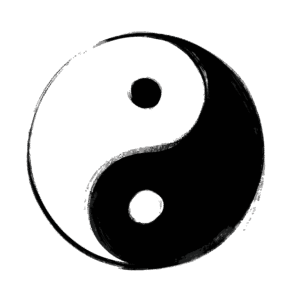
The qualities of these methods reflect the very elemental relationship they’re responding to: inside the stable routine, which we might call “yin,” is the acceptance and cooperation with change, which we might call “yang.” Inside the willingness to change with time and situation (yang) is the longing for consistency (yin). These twin paradoxes are represented in the yin-yang symbol, but also in the Earth itself. Inside the orb of rock and water moves the circulating air currents and transformative processes of life; and our very yin planet revolves around a burning, radiant ball of gas.
At this point in our seasonal transitions, the duality of yin and yang can feel especially dysregulating—both frustrating and hopeful at the same time. We’re deep enough into spring that yang is clearly on the rise, but perhaps not in a consistent way (hello, 80-degree days followed by snow; hello, declarations of war in the same week as the daffodils’ blooming). We’re ready for something new, but deep down we might be holding back because of what we think we know. Will it be as hot as it was last summer? Will this vacation (with or without family) finally meet my dream expectations? Will I even be able to take the rest I know I want and need? Summer, a season defined by peaks and fantasies of our imagination, is also the season where we can experience the greatest falls and disappointments. But we’re not there yet. There’s enough yin still in the system to hold down, or even block, the yang. Our vision of the world, and ourselves in it, is not as sharp as it could be—like looking up from underwater, or from behind sunglasses.
This midway point between spring and summer may not be a formal seasonal transition, but it’s an in-between of the in-between—a concentration of fire that’s acknowledged in the Celtic tradition as Beltane (aka May Day). On May 1 (also a full moon in Libra, which is ruled by Venus, this year—how dreamy!), we are blessed by the energy of the Mother—a ripening into a role of creativity, nurturing, and being-in-it-ness that defines the middle stage of life, aka pitta season, aka summer. It is a moment you can plan and prepare and dream for forever—the whole Maidenhood of spring—but be utterly unmoored by when you’re standing it in, under the high-noon sun with no hat. While I have not birthed human children, I know from my various artistic, intellectual, and somatic creations that once you’ve made a thing, you’re never the same. It happens in a white-hot, black-out fugue state that you know you were there for, obviously, but seemed to happen on another plane of existence. And while obviously these cycles apply to all beings, the connection to the feminine is not accidental. The kind of heat and light of change isn’t the same as the relentless, never-changing sun. Women’s light is never the same, and our more yin bodies, like the watery earth, are the necessary containers for that dynamic fire. The heat of the process (hormones in the case of pregnancy; digestive enzymes and bile for eating; rajas or tejas in general creativity) is so intense, so total, that you’re incinerated at the end—and not only reborn as yourself, but reborn as more-than-yourself, from the ashes. 1 + 1 = 3.
We have some choice, thankfully, over what and how and when we create—a blessing many women have not had throughout history, and still don’t have today. But none of us can choose not to be transformed. As children of Sky and Earth, of Sun and Moon, of bodies who collided and merged in divine alchemy, we are the inheritors of a light that cannot be shrouded. Beltane asks—demands, like many mothers do—that we accept our charge and tend to our-selves so that our Selves keep shining. To build the yin so we can be the yang.
This is what, even from behind my sunglasses, the butterflies revealed to me. And it’s what we’ll be practicing during this late-spring season in preparation for the peak of yang that is the Summer Solstice.
**
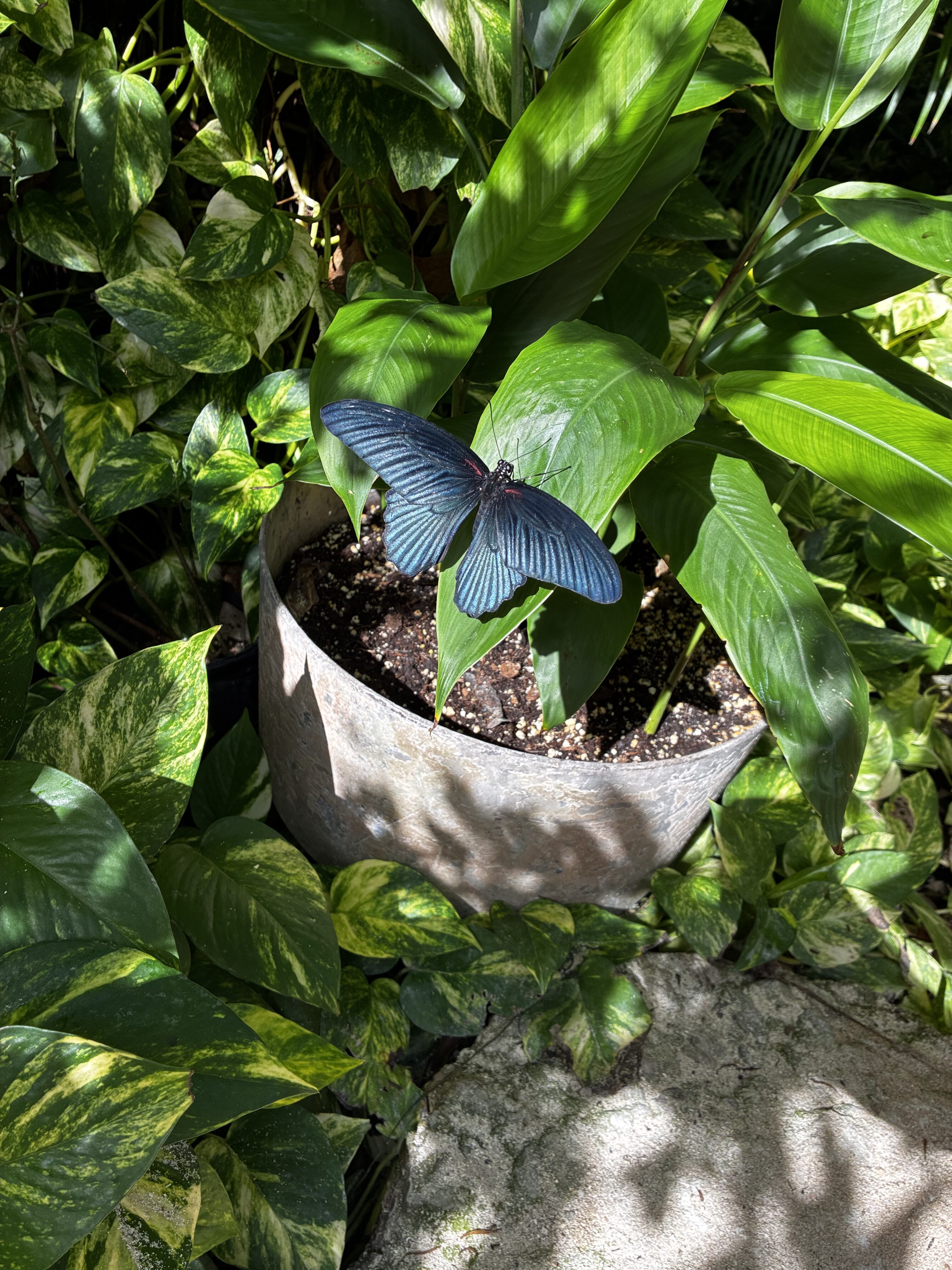
The garden on the other side of the mesh and vinyl wasn’t big or fancy. It didn’t need to be, because they were there. Black wings with red tips, long orange wings, wings that were brown and sworled on the outside and sometimes cerulean, sometimes aubergine (you had to wait long enough for them to wink at you) inside. There was one, shy white one, one iridescent black with a fluted texture that I knew, somehow, was mine. There was the green one (Malachite, named for the color of the panes on the wings and its jewel-like chrysalis) that landed on my knee while I listened to the tour guide explain their metamorphosis.
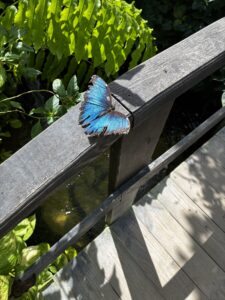
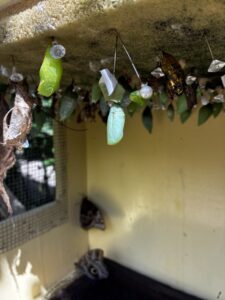
Every two weeks or so, he explained, an ordinary FedEx box arrived with new friends. From Costa Rica and, curiously, Colorado, the garden received chilled chrysalises (and some cocoons, because moths matter, too). Made of keratin (like your fingernails), these sturdy but delicate structures are where caterpillars experience their own form of Beltane—being transformed through creation, readying themselves to become mothers (a more contentious comment from the guide: “the butterfly’s sole purpose is to reproduce”…), surrendering the world they knew to fulfill their purpose of butterfly-dom. And while some chrysalises are eye-catching and sun-glinting, the work of butterfly-ing happens in the dark. It also happens in water. Inside the shell, the caterpillar’s form liquifies, and in the aqueous goo the intelligence of its cells—the knowing of its future, the dhātu dhāra kalā, the yang inside the yin—shines, orchestrates, and ripens the butterfly into it Self. You can identify the species by the chrysalis, but you can’t always be sure of the color of the wings that will emerge. That’s only known when it’s ready to meet another kind of light, to live for a mere handful of days for beauty, and for the future.
Listening to this guide, I was utterly transfixed. So many questions flitted through my head, but I held back (I assumed the two small children also listening wouldn’t be entertained by my probing, nor would the other adults). You can take the girl out of school, but you can’t take the learning out of the girl, I thought. And there it was. There I was. I’d arrived in the moment—on the Butterfly Farm, on this vacation, and, totally as myself. After the talk ended, I took another turn through the flowers to make sure I was feeling what I thought I was. The tranquil stimulation, the dance between bugs and buds that seemed suspended in water, was so much to take in—and yet my eyes (and my phone camera) didn’t feel the pressure to restrain anything. By being so there with my whole body, I was a non-interference that made the flow all that much smoother and more transfixing. All the armor and heavy baggage of the trip melted away. I absorbed into the field of color and smell and texture around me—as buoyant as I was while floating in the ocean the day before, but also part of that ocean, a drop of goo in the sea of becoming.
Relieved of the need to hold on to my one self, I was visited by the caterpillars of my past. In my mind flashed the famous images of Vladimir Nabokov, one of my favorite writers in college, in high socks wielding a huge butterfly net; I thought about how this brilliant man, this crafter of linguistic riddles, several of which feature the Red Admiral as a central image, was a nearly professional-level Lepidopterist and even named two of his discoveries after his adored wife, editor, and rescuer-of-Lolita (Morpho verae [Vera’s Morpho] and Papilio verae [Vera’s Swallowtail]). I thought about the malachite egg that called to me from a gift shop on a spiritual retreat, where I was burning with fever and heartbreak but stepped into a forge of dharma, mantra, and friendship that changed me forever. I thought about all of the people I wish I didn’t think about anymore, and the ones I wished desperately I should share this with; they all fluttered by just the same. I thought about all the leaps into the unknown I’d taken before, and flew. What was different about this time?
At one point I said to my mom, “I love it here. This is where I belong.”
“I knew you would,” she said with a knowing smile. (Of course she did; knowing yourself is even easier when it’s outside of you, in another body.)
Was I qualified to be a butterfly farmer? What papers would I need to move to this island nation? I walked back through the mesh-and-plastic curtains seriously asking these questions, already mourning these creatures whom I’d never see again in just this way, mourning that first moment of stepping into the garden, the rush of feeling my me-ness both heightened and dissolved at the same time. But I also knew exactly what I was going to write about and teach when I returned home. And didn’t feel the anticipation of having the moment end any sooner than it needed to. Who knew what other butterflies I’d encounter with my eyes so open?
**
This season, we’ll draw in the element of water, and the sense of taste, that’s the necessary container for fire to do its work of transformation in order to dive into the goo of metamorphosis together. This word itself is an interesting example of the practice, as it is a description of an action and an inextricable part of a compound word—a hybrid part of speech, a linguistic in-between. It might seem as if we just did a lot of work burning off excess water, and that’s true. But a more refined way of thinking about how we work with kapha season (early spring) is circulating and moving stagnation rather than drying up. As we know, water is essential to life, and dryness is the antithesis to life (per Āyurveda, as the vāta doṣa, and in many other traditional systems). At the end of winter, the heaviness we feel due to kapha needs moving and changing, with the help of wind and fire, which may result in some evaporation along the way. But evaporated water doesn’t disappear, and we need the rains of late spring to ensure the blooming of flowers, which in some form or another produce the seeds and fruits of their longevity—their rasa, the word in Sanskrit for juice, sap, flavor, taste, and the tissue tied to lymph and the fluids of nourishment (breast milk and menstruation).
Like all elements and senses in Āyurveda, water and the sense of taste have a concentrated effect in some areas of the body (the mouth/tongue and genitals), but they’re really systemic (butterflies taste with their feet!). Especially when we think about “taste” more generally—as the qualities we associate with our unique perspective, what we choose to surround ourselves with, how we present ourselves to the world—this sense is even more of a definition of who we are than the egoic and shape-giving sense of sight and element of fire. While light reveals things and makes distinctions, it is inherently dry and separating. Water, on the other hand, coheres. It binds our various parts to our Self and, more importantly, binds our individual Selves to the universal. Together, fire and water make up the pitta doṣa—the hot liquid that acts as a catalyst for every digestive process in the body. Without the watery medium, internal fire would burn us up; inside water, fire becomes life-giving.
Water is the epitome of the present tense in the progression of the elements. It contains all the potential of space, the movement of air, the transformation of fire, and the cohesion of itself. After water comes smell, and by then you are already Whom You Have Been—a memory-in-the-making. Water asks us to taste life and be satisfied by your enoughness—and so pleased to share yourself that you become a beacon of nourishment that others are designed to be drawn to.
The butterflies were no exception to this reality of water. While mostly associated with their color and movement, it’s only through their ecosystem that they have meaning and direction. Seeking the sweet nectar of flowers or the sugar of fruits (we learned that the clumsy-looking butterflies might actually be drunk on the fermented sugars of fallen fruits), their path is governed by a pursuit of rasa. Even the essentialness of their reproductive cycle, which might feel dismissable when put in human terms, has a nobility to it—the female is the one who judges the male’s fitness, then lays 400 individual eggs. Monarch butterflies are famous for their two-way migration pattern, traveling up to 3,000 miles to find a place to reproduce. If that isn’t proof that delicate is the new strong (and for a return of the matriarchy), I don’t know what is.
Our approach to practicing taste through movement will take a few forms. We can’t let a Beltane-plus-Full-Moon go by without honoring soma, and breaking down some of the more linear sequences of early spring with curves, spirals, and arches (all of which will feel a lot better and more stable because of the sight/fire work we did…). But we’ll also move up the lower chain from the feet and ankles to explore the knees, one of the physical and energetic homes of the water element (in the form of jing, a form of “life force” described in TCM similar to ojas). Through supple knees we’ll be more prepared for the seated practices coming later in the summer (that’s right, squatting will slowly fade out…but not quite yet). Depending on how the pollen shakes out, lymphatic drainage will also come into play for friends with allergies.
Inside all these shapes will be the question that the butterflies posed to me, with their urgent beauty and disarming energy: who are you willing to dissolve into? I can’t know the future of my family dynamics, my financial security, or even my health—all of which were weighing on me when I went on my vacation. But I have no doubt that drawing sharper lines and taller walls around myself won’t be at all helpful in making me feel safer, more content, and more connected. At one point toward the end of the week, we were all in the ocean, bobbing and laughing at something I can’t totally remember. The sun was bright overhead and the water was glistening. There were no butterflies around, but there was a morphosis. And it was all of us, completely different and exactly the same as we always were.