Welcome to 2025! I’m excited to kick off the year with not only the usual fare of a new inspiration for my personal practice and teaching, but also coming to you from this new platform. As I continue to refine and transform the ways in which I share the ancient teachings of yoga, Ayurveda, and herbalism, I’ve been consistently reminded that writing is one of the precious gifts I’ve been given in this life. As such, I’ve moved my monthly newsletter to this Substack, where I can put more emphasis on teaching—and connecting with you—through language, even as what I share here provides a creative container to the movement practices and clinical work I do off the page.
This first post of the year has a few more logistics to get through than usual, so if you’re ready to skip to the main event you can scroll down. But I think you’ll want to hear how my offerings will be expanded here on my Substack, as well as through my one-on-one consultations, courses, and workshops.
Because it serves so many purposes in my life, the writing I do in the form of mini-essays on my monthly teaching themes will continue to be available to everyone on my email list. I.e., with a free subscription to my Substack, you can enjoy the full text of my monthly newsletter. If you have the resources and would like to enhance your personal exploration of these themes with me, you can upgrade to a paid membership and receive two pieces of bonus content per month: a recorded yoga practice (~30 minutes) and an herbal monograph + recipe, both of which will relate to the monthly theme. Taken together, you’ll have content to support your mind (writing), body (movement), and spirit (herbal medicine, but really all three)—the full holistic package!
Starting this year, I’m also refining my approach to one-on-one client work. One of the biggest insights I’ve had of 2024 is that I’m a teacher at heart, which means that I cannot simply hand out food lists or formulas to my clients to support their health with integrity and with respect for Ayurveda. Anyone who’s worked with me in the past knows that I love explaining the whys behind my protocols—and you can ask any of my own practitioners that I always want to know the why myself, so it’s no surprise! That said, I’m repositioning my offering as a clinician to be oriented around Ayurvedic education. Yes, when you work with me you’ll still receive personalized recommendations for your health concerns. But you’ll also get all the whys—through a schedule of regular meetings to reinforce accountability and compassionate self-awareness.
In other words, you’ll be signing up for a personalized training in Ayurveda—with you as the syllabus.
Real talk: This is an investment in time, money, and energy. I’m not a mean teacher, so we’ll make adjustments when life inevitably happens and throws us off schedule. But I will ask for your commitment to learning—including, and most especially, when things don’t quite work out the way we expect them to.
If you’re interested in walking this middle path with me, you can read more about the new client program on my website, and book a free 30-minute intro call here. I can work with people in-person in the NYC area, and online via Zoom.
Lastly, I’m excited to announce my major project for 2025: a new book! The idea for this book has been percolating since 2021, more or less immediately after I published Root & Nourish. Its first iteration didn’t get off the ground, so I put it aside until last summer, when I received the motivation to return to it with fresh eyes and a whole lot more education and experience to inform what I wanted to share. One of the cornerstones of my teaching, the book will focus on the role of the senses in our mental health per Ayurveda. Considered the intermediary between the external world and our internal world, the senses are a significant, yet overlooked, part of the Ayurvedic approach to health and longevity. The book will present the truth that sense-care is self-care, explaining traditional dinacharya practices—hygiene for the sense organs—as well as other daily and seasonal rituals.
On top of the poetry and resonance of the Ayurvedic texts, what’s made Ayurveda come alive for me most during all of my studies is the real-life stories of the teaching in action. And so in order for my book to be an authentic representation of this living science, I need stories! Yours! This is an open call for your experiences with dinacharya—how caring for your senses has changed the health of your body, mind, and spirit. If you have a story, please send me an email with a short description of your practice, and we can schedule time to discuss further. My intention is to include one client story per sense in the book (so five total), but there will be ample opportunities to share more—so don’t be shy!
I’ll be sharing updates on and sneak peaks of the book all year in this newsletter, and I look forward to hearing how the content resonates with you. Sense-care has been one of the most transformative aspects of my Ayurvedic journey, and during a time when the macrocosmic aspects of our lives can seem overwhelming and, frankly, scary and depressing, it’s crucial to remember our innate power and capacity to recognize joy, satisfaction, and contentment amidst it all.
Which brings me to the present moment, and the theme—more like quality, or state of being—that’s been at the forefront of my mind and senses since the summer, when all of the pieces of my teaching I described above started coming together: CLARITY. I’ve been using a word or phrase to set intentions for the new year for some time now, and I like to let the word find me rather than trying to project a sentiment into the universe. So when I felt the undeniable urge to return to my book project after three years of latency (it needed to be written!), when I found myself gravitating toward quartz wands in the crystal corner of the apothecary where I work, when I finally—finally!—understood what it meant to open my throat chakra, it was, well, clear, that clarity was the force behind it all. It even felt a bit silly to wait until January to formally work with this energy, but in the six months or so since it’s been doing its work on me, the ways in which I can share and teach it have only become (can you guess?) clearer.
My work on this theme arose not from clarity itself, from the familiar and frustrating place of stagnation—perhaps an even more ideal place from which to begin any journey. I’d just started seeing a new body worker, who within 10 seconds or so, without even laying a hand on me, identified that my throat chakra was blocked (energetically, but also manifesting in steel-rope bands of tension in my neck). It took all of me not to roll my eyes at his observation. I’d been hearing the same thing for years, from reiki masters and massage therapists and cranio-sacral therapists and astrologers, who despite their certainty offered no helpful explanations or suggestions on how to un-block the chakra other than “speak your truth.” As far as I knew, I had no hidden secrets, no capital-T traumas locked away in my tissues. And I have always been a strong communicator. My first loves were reading and writing; my sister sometimes says I “speak in paragraphs”; and the butterflies I get before public speaking are a species that flitter with excitement and passion, not dread and fear. What, then, was blocked in this area of my body? I was ready to dismiss this practitioner, too, until he explained the role of the throat chakra in a way I’d never considered before. This understanding not only cleared the physical and energetic tension, but inspired this entire next year’s worth of teaching (and probably, hopefully, far beyond).
The throat chakra, or Vishuddha, is most commonly described as a center of expression, individuality, and truth. Makes sense, right? It’s the home of our “voice,” literally and metaphorically. In my various Ayurveda trainings, I’ve heard of case studies where people who cannot express themselves—because they don’t feel safe enough to, because of a trauma, because of oppressive power dynamics, because of being forced into jobs or relationships that aren’t true to them—develop issues with their thyroid, the butterfly-shaped gland that sits just above the valley of the collarbones, that spot that clenches when you’re trying not to cry. The thyroid is responsible for controlling a host of bodily functions, especially metabolism. A malfunctioning thyroid essentially puts you out of sync with the rhythms of the universe—when to digest and when to eliminate, when to grow and when to stop, when to expand and when to contract. While the throat chakra is not limited to the thyroid, their pairing highlights the overlap between emotional expression and the regulation of our expansion and contraction at every level. Cycling between expansion and contraction, you might then say, IS the fundamental truth of our existence that’s longing to be expressed through our voices, our actions, and our very being. When we cannot cycle between these phases, we aren’t expressing the truth of our spirit. What the throat chakra needs, then, isn’t more or less or better or different content to be expressed; it needs clear, open space through which our truth can move. And can you guess which element is associated with the throat chakra?
The placement of the throat chakra for this purpose isn’t a coincidence either. At the juncture between the head and the body, it acts as a thoroughfare between unmanifest reality and the manifest. When we spend too much time in the unmanifest (aka, in the mind), like I have for most of my life, the thoroughfare can become easily overwhelmed; similar to how your computer goes on the fritz when you try to download a file that’s too big, or have too many tabs or applications open—there isn’t enough bandwidth for the transmission to take place. The ideas, desires, feelings, and, most importantly, the spiritual wisdom from the divine that comes down through the crown chakra might get stopped up in the throat on the way to becoming reality. Likewise, if the body is not grounded, stable, and spacious enough to receive those downloads, then the throat becomes the waiting room for all that energy. The street that our higher selves travel to become manifest reality—the desire of the supreme consciousness to know itself that began all life as we know it, according to Samkhya philosophy—is definitely two-way.
And just like that, it all became clear. Lying on the treatment table, I felt my lungs take maybe the deepest breath of our life. When I next opened my mouth to speak, the pitch of my voice—naturally a resonant Alto II—dropped at least half an octave. For the next few days, my voice didn’t get tired and hoarse after teaching like it usually does; and I relished in how easily the cues for my sequences came without having to plan—including how and when to say less.
But that initial opening wasn’t the end of the work. The neck tension was back—maybe worse than before—at my next session, and while it subdued it after 90 minutes or so, I knew that I had to figure out a strategy to maintain the space in my throat on my own if I wanted to hold onto the clarity I’d discovered sans blockage. I considered all the usual voice-related tools: mantra meditations, singing, brahmari pranayama, even reciting poetry aloud. None of these felt right, until one morning when I was trying on different poems to read during my meditation. It wasn’t verse, but an artistic manifesto of sorts, from one of my favorite poets that slipped itself into the locked door of my throat chakra:
“The symbol of all art is the Prism. The goal is unrealism. The method is destructive. To break up the white light of objective realism, into the secret glories which it contains.” —E. E. Cummings
The image was almost too easy. My throat was a prism, a clear, open channel through which pure light could filter and break up into its multicolored, kaleidoscopic frequencies of expression. Holding this truth in my throat, I felt the area expand in all directions. Warm, soft. No tension. Only space, the purpose of which is to act a container of transformation, of refraction, of alternating light and shadow, of oneness as a singularity and as an entirety. When I went back to my next body work session, we were both surprised by how drastically I could change the state of my tissues with my mind alone—or, rather, by how letting my mind loose into the space of my throat resulted in a state of ease.
Armed with this secret Jedi mind trick, I sent rainbows of light from my throat, and leaned into space, wherever I could. I’ve always been a minimalist at heart, and I stopped feeling bad about my preferences for less. This included honoring my introverted need for alone time, which in the recent past I’d been working hard to “overcome” as if it was a problem. While challenging our tendencies (especially when they’re not supporting our health) can be a positive thing, and can allow us to enter into supportive relationships and discover new aspects of ourselves, it’s also important to know who we are—to speak our truth. For me, space is non-negotiable, and now I feel more confident in expressing that need rather than stifling it away for the sake of not upsetting others. As icing on the cake, I took a course on the concept of elemental constitutions at the end of last year—similar to the dosha theory of prakrti, but breaking it down further into five types instead of three, with different areas of application in our lives (work, relationships, and private self). I wasn’t at all surprised that my dominant element was space (secondary air; i.e., vata). Space types, the teacher said, are naturally quiet and philosophical; they think big-picture, a whole concept rather than its individual parts, and can sometimes have trouble distilling their thoughts into communication or discrete action items that others can understand or act upon (I get some help in that area from my air element). Listening to this description, I almost cried. This was me, and it was okay to be this way! These were strengths and skills I could choose to put to good use, rather than seek “balance” through the opposites that always felt forced, uncomfortable, and draining.
With this framework, it became clear why I teach the way I teach, why not being enrolled in some sort of school or training creates a vast emptiness in my heart, and why I speak in paragraphs. Just like in my very first Ayurvedic consultation, the practice reflected a truth back to me with lovingkindness and a challenge to embrace my qualities as gifts, not obstacles.
And this is what 2025 is for. Unleashing the secret glories of objective realism. Speaking my truth not by sharing a deep dark secret, but by creating enough space in my throat for my great-big mind and spirit to become manifest. To teach my mind to come home to my body, with my body. To birth a book. To be a mother to ideas that will change someone’s life—maybe even my own.
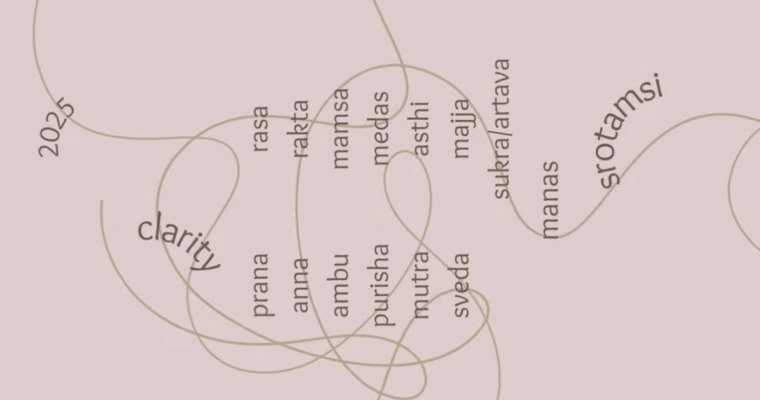
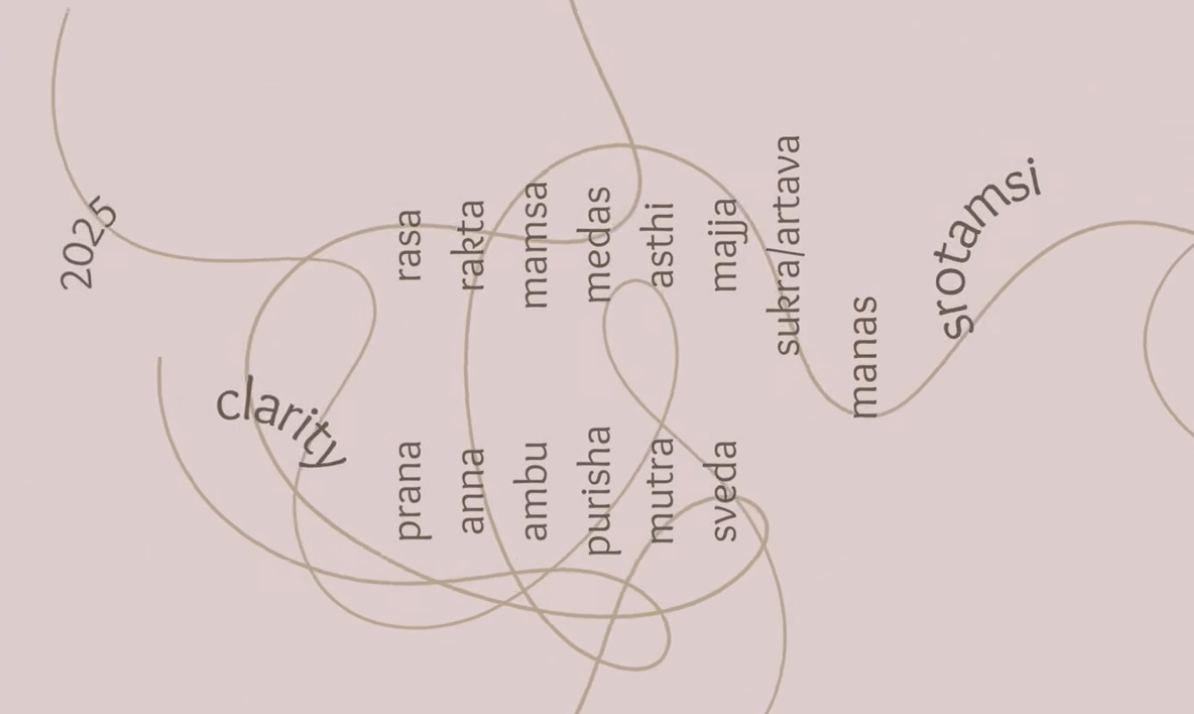
While there is an elegant synergy between the clarity and spaciousness of my personal truth and the clarity and spaciousness of truth itself, I knew this wasn’t a lesson that only space-types needed to hear. So I retreated to the capacious rooms of my mind and retrieved the perfect concept through which to teach clarity through movement: srotamsi. The translation of “srotamsi” (plural) is “channels,” or “those that carries things,” which to me made it an obvious choice for exploring clarity. We always, always want the channels to be clear; if not, nutrients, fluids, information, energy, Prana, etc. cannot circulate and do their thing to promote life. Most Ayurvedic therapies, in one way or another, work to clear some channel or another; all of yoga is about clearing the channel of the mind via the senses and attention. But since srotamsi is considered a more “advanced” concept in Ayurveda, used in clinical applications when considering the etiology and pathology of disease states, I paused before committing to this framework for teaching yoga. Was it too esoteric, too technical? Well, we have the next twelve months to find out.
Jokes aside, I’m confident that srotmasi will serve us well in 2025 because of how this concept opens a big, wide door into exploring and supporting what we all need help with: the mind. Ayurveda and the other Vedic philosophies describe many kinds of channels—including “nadis” (e.g., nadi shodhana pranayama), which are more subtle—but the 13 channels in the category of “srotamsi” are decidedly gross in nature. They’re literally the spaces in the body through which the elements, in their various forms, move; they’re the veins and arteries, the nerve bundles and muscle fibers, the organs and orifices. Each has a specific root or origin point (mula), a pathway (marga), and an exit (mukha), and in one way or another they all connect to each other to form a complete internal circuit, with exit points at the senses and organs of elimination. In other words, a very elegant and sophisticated plumbing system.
The srotamsi can be divided into three general categories:
Ingesting/”Food” (3)
- Pranavaha srotas—air/life force
- Annavaha srotas—food
- Ambuvaha srotas—water
Elimination/Waste (3)
- Purishavaha srotas—feces
- Mutravaha srotas—urine
- Svedavaha srotas—sweat
Dhatus (tissues) (7)
- Rasavaha srotas—lymph
- Raktavaha srotas—blood
- Mamsavaha srotas—muscle
- Medovaha srotas—fat
- Asthivaha srotas—bone
- Majjavaha srotas—marrow/nervous system
- Sukravaha srotas/Artavavaha srotas—reproductive tissue (male and female)
Thinking back to when I was in Ayurveda school, I wonder if my teachers were having an especially fun time while teaching the srotamsi. Not only because it’s complicated and throws students for a loop—just when we thought we understood things, it all got weird—but more because of the weirdest part of this list of channels: the “plus one.” Yes, when you read about srotamsi in books, you’ll always see them enumerated as “13 + 1.” Why not just say fourteen? What is this mystery plus-one? The channel that’s everywhere (its marga, or pathway, is “the whole body”), doing everything, easiest to become imbalanced and hardest to heal. It’s the manovaha srotas, or the channel of the mind.
The manovaha srotas, as I discovered through my work with the space element and throat chakra, unlocks the door to a life that is clear, aligned, and truthful. As we’ll explore throughout the year, it’s this srotas that has the biggest effect on all the other channels, which means its clarity is of utmost importance. Hence the entire philosophy of yoga, dedicated to a clear mind. Hence the increasing number of diseases of “unknown origin” affecting people today, those which originate in the mind (and, usually, associated with vata dosha) and manifest in the channels through which the mind moves, aka the body.
By this I do not mean the throw-away, dismissive, and often highly insulting declaration of some pain or illness being “psychosomatic.” The imbalances that originate in our mind aren’t made up—they’re simply stuck in the thoroughfare between mind and body, unsure of how to express themselves clearly, but dying—sometimes literally—to be acknowledged, heard, felt, and held. If something is “all in your head,” it is literally all over your body, traveling through the manovaha srotas and touching every tissue, organ, orifice, and cell. We cannot approach this situation with a “mind over matter” attitude; rather, we all need a reckoning with the truth that matter is over mind—that the mind will become a poison if the matter of our body is not clear, open, and spacious. If the mind cannot expand and contract, it will destroy its own home.
When we work with the srotamsi, then, we are giving our minds the best shot to move, transform, and become manifest in ways that support our health and that of our communities and the universe. Not everything that passes through our heads needs to become something—gosh, no!—but everything does need to be digested and absorbed or eliminated, literally or metaphorically. No wonder the GI tract is called the “mahasrotas”—the great channel: our bodies are really nothing more than a network of artfully contained spaces. To live in a state of truth is to occupy those spaces with integrity; to be mindful of what we put into them and what we release from them; to practice sukha, good space, in our words, actions, and thoughts.
Each month of 2025, we’ll focus on one srotas (except for February, the month of exceptions, when we’ll combine two), but always keeping the manovaha srotas in mind (pardon the pun). Through postures that align with the mulas, margas, and mukhas of each srotas, we’ll experience how that channel supports our overall system, observing the macrocosm of our body in the microcosm of a group of tissue structures that work together to do a job.
Now, here’s a spoiler for the maha-why behind all this awareness, teaching, and practice. Over our twelve months, the various channels will wind their own paths, but ultimately there’s only one destination: the heart. As the root of the manovaha srotas, as well as of the primary srotamsi of body and spirit (so all three pillars of our being reside there), the heart is our personal center of gravity, where our mortal life starts and stops, from where our mind contracts and expands, and where our spiritual life continues infinitely before, during, and after our bodies exist in this form. So in caring for the srotamsi, and by extension for the mind, we are practicing for and from our hearts. Where, as Lorin Roche describes in his translation of the Radiant Sutras, “everything meets…mind, senses, soul, eternity…[where you are] saturated with knowing, ‘I belong here, I am at home here.’”
Isn’t this the space where we all want to dwell, forever? In “the bowl of vastness that is the heart”? We might pause to consider how we deviated from this channel in the first place, how we were lured off the path to the heart and towards…pleasure? distraction? greed? fear? Rather than feed those delusions with our attention and our prana, we might simply choose to reroute our navigation system. Now. We can come home to our hearts, practice with enough clarity to honor the truth of ourselves, and remember that we’ve been here the whole time. That any channel we take will lead us back home.
In the chakra system, the heart (anahata chakra) and its associated air element live just below the throat. The heart provides the throat with fuel, just the way that the purpose of space is to be a container for air’s movement. So as we begin our journey through clear channels in 2025, we are starting at the source—the heart, the air, and pranavaha srotas.
Whenever we look at lists in Vedic texts, the first item on the list is usually the most important and can even encapsulate all the other items on the list. This is true for the “yamas” that begin the eight limbs of yoga—ahimsa, or nonviolence, being a guiding light for everything we do in all of yoga. This is true for the first word of the first verse of the first veda—agni, or fire, which is the (literal) guiding light for our human existence. This is also true for the srotamsi, where number one of thirteen is pranavaha srotas. It’s arguably the most important channel, since without breath—the gross form of prana—we die; and without capital-P Prana, our life force, we would never be willed into existence by the supreme consciousness.
The pranavaha srotas is intimately involved in all functions of the body given the importance of a steady supply of oxygen. Its jobs include: respiration, energy, cellular intelligence, emotions, and communication with the Higher Self. Although we primarily work with this srotas in a respiratory sense, it’s important to remember that the body also derives prana from food—hence the role of a calm nervous system (which expresses in a smooth, slow breath) in proper digestion. The other anatomy points to consider are:
- Mula: heart & mahasrotas (GI tract & rasa dhatu)
- Marga: respiratory tract
- Mukha: nose
Yoga for the pranavaha srotas is not only breathwork. While we’ll spend time exploring the muscles and structures involved in respiration (the diaphragm, the ribs) as well as the pathways of breathing through the chest and throat, we’re also looking at a more subtle expression of prana as it connects to the mind/emotions and spirit and its ability to support us right now, in January. In mid-winter, we’re all struggling—including prana. Vata, the flaky and mischievous cousin of prana, has been building for months, and vata’s tendency to be erratic and destructive might block the nourishing, steady qualities of its refined counterpart. The days are getting longer and lighter, but oh. So. Slowly. Post-holiday, motivation might be sluggish, along with our digestive and immune systems. It might be tempting to jump into invigorating practices—new workout routines, resolutions, etc.—but the body will be reluctant to reduce itself (langhana) when it’s still holding onto all the energy it can to stay warm and alive in a season of scarcity. Respiration itself is particularly vulnerable, not only from colds, flus, and other viruses, but also from the dryness of indoor heating—and the dry energy of grief and loss that can cast an emotional shadow over this season for many.
The strategy, therefore, is to move slowly, subtly, stealthily. To start churning from deep inside, without sounding any alarms that would poke at vata and constrict the channels further out of fear. (Think of the relationship between vata and prana like this: Vata keeps you alive in an emergency, help your heart and lungs and legs to move fast and survive. Prana keeps you alive the rest of the time.) To gently coax agni out of its winter sleep and rekindle the world, including us. If we are truly aligned with Prana, we’ll trust that going slowly is okay. That if we take our time, the reality we want will manifest itself. That if we stay still until we’re ready, what arrives for us in spring will have strong roots and enough space to bloom into.
Prana teaches us to receive lightly, but deeply. To drink in that which is unseen and let it change us cell by cell, breath by breath. To hold our breaths—not in anticipation of whom we’ll become, but in a loving embrace of who we are.