![[excerpt] What is Dinacaryā?](https://jenniferkurdyla.com/wp-content/uploads/2026/01/SCSC-bookshot.png)
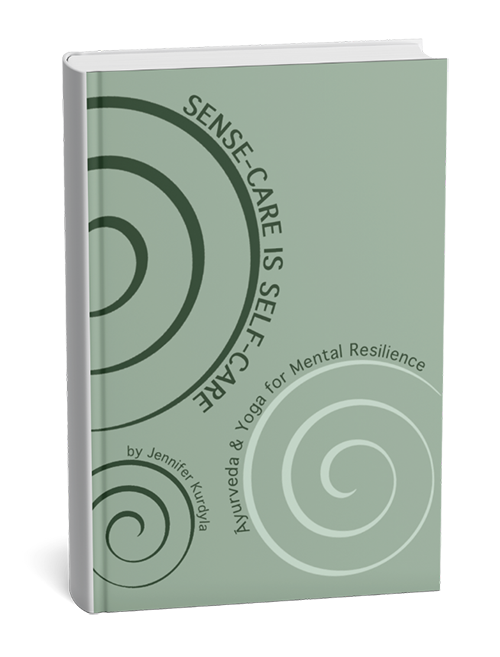
from Part I of (c) Sense-Care is Self-Care: Āyurveda & Yoga for Mental Resilience (2026)
“Why would you want to do that?” The words came out of my mouth faster than my brain could catch them. Everyone in the room—my dozen or so classmates, the teacher, and the teaching assistant in my 200-hour yoga teacher training—turned to look at me, and then broke out into laughter. Clearly, I wasn’t alone in questioning the concept of pratyāhāra—the Saṁskṛta word for “withdrawal of the senses,” which we were discussing in that day’s yoga philosophy lecture. Step five in the eight-limbed path of yoga seemed not only undesirable, but harder to achieve than some of the more complicated, acrobatic āsanas, or postures, that we were learning to practice and teach.
I’d found yoga several years earlier during my sophomore year of college—a “prescription” of sorts from one of my first psychotherapists. Having grown up in the late ‘90s and early ‘00s, I was raised in an era of consumption and achievement which, combined with my anxious and sensitive disposition, made me a poster child of high-functioning perfectionism. When I arrived at university and realized that I wasn’t, actually, in total control of my future; that no matter how hard I studied or how many rules I followed, things didn’t always work out the way I expected; that I was fooling myself for ever believing I belonged there; that I’d never be good/smart/attractive/worthy enough—my perfectionism spiraled out into full-blown mental illness that threatened my identity in pretty much every way possible. So when my therapist suggested that I try yoga, a practice I didn’t know much about but she assured me was kinda similar to my favorite pastime of dancing, I obeyed. Desperate to regain my sense of self, I got myself a mat and some leggings, showed up for class every week at my college gym (we practiced in the same room as the fencing team; I don’t recommend learning to do standing poses and jump-backs on a springy mesh floor . . .), and waited for everything to go back to normal—to go back to being me.
As my therapist explained, yoga would help me “heal my relationship with my body,” which had become severely damaged under the stress of my teenage years. To clarify, both my body and the relationship were damaged—a multi-layered kind of illness I didn’t fully appreciate until much later. I admit that I didn’t immediately take to the slow, breath-based movement. A life-long dancer, I was flexible and knew how to follow movement cues and remember sequences. Through dance and the other more intense forms of exercise I preferred, my nervous system was locked in a baseline state of upregulation that contributed to the aforementioned damage, which I wasn’t keen on letting go of. In fact, going slow and being still at first caused more anxiety. On the first day of YTT, so many of my classmates shared how they’d fallen in love with śavāsana, the “final resting pose” in most yoga classes where you lay on the ground for several minutes at the end of class. To me, śavāsana was an utter waste of time; when I practiced at home with my yoga DVDs, I’d turn off the video once we got to that last pose, and would use the time in a live class to mentally review whatever I was studying or make to-do lists. Even when I really tried to do śavāsana, my body rebelled— pain seared down my spine, and my arms and hands would twitch uncontrollably as soon as I approached a state of relaxation.
Despite this mixed first impression of yoga, however, something kept me returning to my mat even after I graduated college and was out of the gaze of my healthcare team, who supported me with nutrition and psychological resources. I sensed that my body was healing through the practice—the steady pace and space for rest quelled the storm of depletion that had been eroding me for years. But I was also healing the relationship in ways that weren’t as obvious as less joint pain and better overall endurance (after school, I worked in book publishing, so the backpack full of textbooks I used to carry around campus was replaced with tote bags full of printed manuscripts I hauled through the streets of Manhattan and up and down the subway stairs). I wasn’t as compelled to withdraw from activities and social engagements, tethered to work and responsibilities and doubting whether my presence really mattered to others. I wasn’t relying solely on the stories that had filled my college brain (I was an English major) to experience life; I craved the joy and romance, the heartbreak and grief, that I read about happening to my favorite characters but was afraid to feel myself. My body was no longer a place to escape or control, but a place to dwell and expand. The un-PC phrase we use to describe someone who’s struggling with mental health—that they “lost their mind”—was a completely accurate description of me pre-yoga. And after a few hundred śavāsanas (which I eventually grew to enjoy, with the help of some extra props and excellent teachers), I’d brought my mind back home to where it belongs: in my body, specifically in the sensory experiences that allowed me to develop and satisfy my self-hood through healthy self-awareness, confidence, and boundaries.
Hence my confusion that day in teacher training. Yoga had literally saved me, but in all my years of practice somehow I’d missed this bit about “withdrawing my senses” (maybe I’d fallen asleep when they explained it one day in śavāsana?). Could I continue to heal my body and mind, and practice with a yoga that included pratyāhāra?
*
Dear reader, you probably don’t have to think too hard to know the answer. Sense-Care is Self-Care: Āyurveda and Yoga for Mental Resilience is the practical, accessible, and inspiring response to the question of how the five senses (yep, the ones built into your face) can act as portals for healing the frayed connection between body and mind that is at the heart of our culture’s mental health crisis—for helping us bring our anxious, distressed, diseased, distracted, and just plain tired minds back home where they belong. Now more than ever, we need to cultivate a state of suppleness between body and mind, between self and others, to endure the deluge of sensory impressions we ingest every day. When we tease apart the functions and states of our mind, which have been understood since ancient times, we can develop the skills and tools we need to spiral in and honor the emotions and instincts governed by our “feeling mind”—which not only keep us alive, but give our reality flavor, texture, and beauty—rather than spiral out in states of overwhelm and reactivity. Through an intentional practice of sense-care, we can access the truth that our inability to “keep up” with the pace of modern life, our difficulty with and resistance to “just relaxing” in the face of widespread hardship and uncertainty, isn’t a character flaw or weakness. From this place of inner spacious and clarity—pratyāhāra—we can use our discriminatory “thinking minds” to take more skillful action that reflects our shared human desire for belonging and love—a state of Yoga.
This radically simple technique is based upon the descriptions of our subtle and gross anatomy in the Vedas, the ancient philosophy from India and the source of yoga (though the physical postures that are popular in modern cultures were not necessarily in the original texts). According to both yoga and its sister science, Āyurveda, the body, mind, and spirit are literally interwoven through a system of physical and energetic channels. Three main channels of body, mind, and spirit that house and circulate these aspects of our being share a root in the heart (both the physical organ and an energetic field). The energy and substances that move through the channels flow away from and back toward the heart in a rhythm—a spiral, if you will. The two-directional movement of the heart-spiral is why I can hear someone call my name, turn my head toward them, and say “hello” in conscious recognition of their words; likewise, it’s why when I read about someone dying in a novel, my body responds with tears and restricted breathing upon being reminded of my lived experiences of loss and emotional pain.
As these examples illustrate, the senses serve as gateways between our external and internal environments. The eyes, ears, nose, mouth, and skin are all places where information comes in, informing the heart-spiral of what’s going on “out there,” and then expression or action can flow out via the complementary organs of action in response to that information. In other words, the senses determine what we feel in our hearts—which is where our mind lives. Therefore, when we care for the senses, we directly influence the state of our mind. And so we spiral between outside and inside, within the unified container of body and mind, via the senses.
We’ve all experienced this sensory web at some point or another. Think about the last time your dinner conversation turned into an argument—how was your appetite? Do you even remember what you ate? How well did you sleep that night? How willing were you to plan another get-together with that person, or return to the scene of the crime? Now, imagine eating your favorite meal in your favorite natural setting (beach, mountains, forest, you pick); the weather is perfect; the gentle swell of the ocean or chirping of birds accompanies your meal; you’re with your favorite people or maybe by yourself. Can you feel the shift in your body, even just reading the description of a more appealing and wholesome sensory experience? The interplay of the senses, body, and mind is what we’d call an Āyurve-duh concept: something so obvious, yet so overlooked it feels revolutionary once it’s pointed out.
Still, when we find ourselves affected by the senses and mind to the point of illness, it’s often dismissed in modern medicine as “psychosomatic.” “It’s all in your head,” doctors tell patients who have felt symptoms, felt dysfunction, felt pain that can’t be detected on scans or in lab work and so therefore can’t be a “real” problem. This attitude is extremely disempowering and, frankly, insulting to the intricate design of the body-mind. To this, Āyurveda says, yes, it is all in your head—because your “head,” your mind, is in your body (plus, Āyurve-duh, your head is physically connected to your body, and your brain a mere organ; it’s not floating off in some corner per the common gesture people make when referring to their minds). And your mind, which is born in the shape of your body, is where reality is conceived. One of the three main causes of disease per Āyurveda specifically calls out a “disunion of the senses” in appreciation of this fundamental integration as a baseline of our health (we’ll learn more about this later). Through paying attention to what our senses take in, and caring for their physical structures, we have the power to radically shift the functioning and internal harmony of the whole system.
Because of the senses’ importance, Āyurveda describes an entire practice called dinacaryā, a “daily routine” comprising rituals that cleanse and nourish the sense organs and generally support homeostasis in the body. The goals of dinacaryā are manifold. First, the orifices of the sense organs act as eliminatory pathways for the waste products that build up after the body undergoes deep digestion and detoxification during sleep. For most of us, its instinctual to want to use the bathroom, clear out eye goop, blow our noses, take a shower, and brush our teeth upon waking or soon after. We wash away the gunk to feel clean, but also so that the sense organs are well set-up to do their jobs while we’re awake. With a clean mouth, for example, you’re better able to taste your food when you eat, sense cues of hunger and satiety, and undergo complete digestion.
Second, the products used to clean the sense organs in dinacaryā are inherently protective, which shores up their resilience to environmental and energetic stressors—the very stimuli that they are designed to take in and filter on the way inside the body and mind. Because the senses are directly connected to the mind, and most of them tend to be open or semi-open spaces, filling or coating them means that they’ll experience less wear and tear while they spend all day fielding nonstop sensory traffic from the environment. You won’t find alcohol-based rinses or sudsy soaps in Āyurveda, not only because those products weren’t necessarily around 5,000 years ago, but because they actually make the body more vulnerable by stripping us of our healthy bacteria. Instead, we use oil—a lot of oil, everywhere. I like to joke that oil is the “Windex” of Āyurveda; the reference is to a popular movie from when I was growing up, My Big Fat Greek Wedding, where an old Greek patriarch would spray Windex on anything and everything that looked a little off on the body, from pimples to mystery rashes—and it worked (I bet it was the ammonia). Oil not only promotes a healthy biome in and on all the body’s surfaces, but the qualities of oil—heavy, dense, unctuous, warm—help to keep the mind flowing inside those surfaces, calm and grounded.
Third, dinacaryā nourishes the mind through the way it directs the attention of senses. On the surface, dinacaryā could be mistaken as nothing more than hygiene. And some days, even when you’ve been practicing for years, it is just that—everyone has mornings when you’re in a rush or wake up in a mood and go through the motions without thinking. But the practice is meant to be a sacred time of intimate communication with your body. We take time to examine the state of the sense organs to assess how well they’re functioning. Eye goop isn’t just something you scrape away, but maybe a sign of something going on; likewise with an unusually stuffy nose or a weird skin thing that wasn’t there yesterday (break out the Windex . . .). From there, you determine what kind of cleansing or nourishment is needed in the dinacaryā—and the rest of the day to address any imbalances the senses communicated to us. In this way, dinacaryā reverses the typical orientation of the senses. Rather than taking in information from the outside, they’re reflecting information about the state of our inner world. By spending even just a few minutes listening to, seeing, touching, smelling, and moving the body, we express gratitude for all of its functions that hum along largely without our awareness or acknowledgment during the day. We turn our attention inward, center and ground our minds, and remember—and literally feel with our hands—our wholeness, before stepping out into a world that’s determined to make us forget that fundamental truth.
Most of the practices in dinacaryā take place in the morning for this reason; they set up the senses to “go to work” all day, spiraling out into the world, collecting and filtering information. But the overall practice of a “daily routine” also encompasses other cycles of our lives and of nature. There are also nighttime practices called rātricarya—what we know as “sleep hygiene.” Similar to the morning routine, these sense-care practices help rewind the mental spiral after having a day out in the world, so that the liver, gut, brain, and more can “go to work” on that deep digestion during sleep. Essentially, these two routines feed one another: a steady morning routine leads to better choices during the day, simplifying the transition to sleep and optimizing overnight “clean up,” which then leads to easier elimination in the morning, etc. Seasonal practices, ṛtucaryā, help the body transition between the major shifts in energy that take place between spring, summer, and autumn (the three main “growing” seasons; winter straddles autumn and spring). There are general templates for all three of these routines, which you’ll discover in this book (and can refer to in the handy cheat sheet in the Appendix), but in the end everyone’s daily routine will look a little different—not only from person to person, but within a single person, accommodating our ever-changing needs.
In the modern wellness industry, “self-care” practices are advertised as opportunities to step away from the daily grind and busyness, to “turn off ” the mind, and spend time alone or with loved ones in good company. This is exactly what you do during dinacaryā every day. Except we’re not turning the mind “off”—we’re turning it “on,” reinforcing the essential integration of body, mind, and senses that we need to be able to survive and thrive “out there.” And the best thing is, even if you only give 80 or 70 or 30 percent of your attention to your dinacaryā, the very act of showing up and repeating the rituals embeds those messages of gratitude and wholeness into the body-mind circuitry. A few quiet minutes of sense-care every day is far more valuable and beneficial to your health than an extravagant spa day or vacation every few months or years.
If I’ve already sold you on the magic of a daily sense-care routine, then you’re in luck: Everything in this book is a form of dinacaryā. In Part II, I provide detailed instructions for the traditional practices performed for each sense organ, plus many more from yoga and Āyurveda, other holistic healing traditions, and a few I’ve cooked up on my own over the years (including mealtime rituals and simple recipes) and have enjoyed myself and shared with clients. The intention of dinacaryā is not to blindly follow a routine—which by definition is about reducing conscious attention to save energy while on “autopilot.” Dinacaryā asks you to bring all of you into the practice—body, mind, and senses. To pay attention to, and make healthful choices for, the one that matters most in this world: your capital-S Self.
*
Sense-care is self-care because it’s through the senses that we can direct the flow of our attention and affect the health of the whole Self. They’re how we make the body a more welcoming place for the mind to “abide,” a place where it wants to come in and stay a while. They’re how we recognize that here, now, with body, soul, senses, and mind united in the heart, we are already at home in our True Nature. Th is variety of “self-care” isn’t hard or complicated— in fact, its simplicity is exactly what the Mad-Men marketers who sell us expensive and unattainable images of “self-care” want us to forget. If self-care is what gives the body and mind stability and contentment, then we can do that with basic Sense-Care Essentials: regular meals, movement, and sleep. It’s that simple. It may seem like a modern problem that we’ve spiraled so far away from this reality. And it’s true that, as the world becomes more complex, we might need to put in more effort and concentration to unlearn, or not become persuaded by, behaviors and thought patterns that further the disintegration of our Self. But remember that these teachings were codified thousands of years ago. The ancient Yogis and ṛṣis (“seers,” who originally received the teachings of Āyurveda) might not have had to deal with pinging cell phones, a 24/7 news cycle, and climate change, but they did have to deal with their inherently distractable, anxiety-prone human minds and inherently vulnerable, death-prone human bodies.
Committing to, and struggling with, a lifetime of sense-care isn’t a Sisyphean punishment or payback for karmic wrongdoings. It’s a responsibility we’ve been entrusted with—to tend to this temporary home we’ve been given and give our souls the best chance at evolution. Every time we stand and the fulcrum of the mind at the senses, where we can actively choose between spiraling inward and outward, we are conducting the heart’s unending symphony. We determine the steadiness of the rhythm, the harmony of the instruments, and the length of the rests. Through our senses, we both listen to and become the music of life itself.
Āyurveda is to free the mind which is trapped in the body. Yoga is to free the soul which is trapped in the mind.
—Baba Hari Das
This kind of sense-care isn’t frivolous or trendy. It isn’t a way to spiritually bypass or turn a blind eye to the challenges of reality with “good vibes only.” It’s urgent, necessary medicine for the health of our bodies and our planet. Sense-care is the antidote to the state of worry, fear, isolation, and overwhelm that is making us pathologically dissatisfied with reality—so much that our minds and bodies no longer know where home even is, let alone how to keep it clean and welcoming. It’s a practice of wakeful acceptance and radical honesty, of patience and bravery. It’s how we will return to the path that consumer culture has been systematically diverting us from for decades, if not longer: the path home to the heart.