That time of year thou mayst in me behold
When yellow leaves, or none, or few, do hang
Upon those boughs which shake against the cold,
Bare ruin’d choirs, where late the sweet birds sang.
In me thou see’st the twilight of such day
As after sunset fadeth in the west,
Which by and by black night doth take away,
Death’s second self, that seals up all in rest.
In me thou see’st the glowing of such fire
That on the ashes of his youth doth lie,
As the death-bed whereon it must expire,
Consum’d with that which it was nourish’d by.
This thou perceiv’st, which makes thy love more strong,
To love that well which thou must leave ere long.
During my long and satisfying time as an English major, I sometimes envied my science-friends who learned all sorts of whacky vocabulary to describe the body, the economy, the world of imaginary numbers, the molecular universe, and all things presumably “measurable” and “provable.” But now, looking back, we bookworms had some pretty expensive words in our pockets: caesura, synecdoche, metonymy. While not a particularly tongue-twisting word, volta, has always stood out to me among this category for its quiet, obvious perfection. Latin for “turn,” the volta describes the line in a sonnet (normally the penultimate line—13 of 14—but it could be anywhere, especially if you get a rule-breaking poet) where the tone, narrative, or sentiment seems to abruptly change. This hard left (or right, again, depending on what kind of poet is working) can clarify and/or complicate the meaning of a poem and, most importantly of all, give an English major enough material to write a 5-7-page response paper.
The volta may seem like a bit of unnecessary poetic trickery—why not just say what you mean?—but when used well it will leave a reader both surprised and unsettled. It evokes a pause, a scratch of the head or furrow of the brow. It affirms everything they’ve read so far, the ideas they’ve been nodding along with and digesting for three quatrains (there’s some poetry-math for you), and then adds in a new element that leaves them thinking—and wanting more. The volta is like that surprising note of tart cherry on your tongue after a sip of rich coffee or bite of chocolate, or the notes of bergamot that take their time wafting toward your nose long after the Mysterious Stranger who just walked by has long gone. It’s like resolving a chord in a minor key, or the bridge lyrics in most Taylor Swift songs (and sometimes the harmonies, if you listen closely/frequently enough).
We are at one of the voltas in the sonnet of the year—the spring equinox—a tipping point that brings about a similar dynamic between us and the sun as between the reader and a poem. In anticipation of the arrival of spring (or fake-spring, as we’ve experienced in an extreme way here in the northeast at the beginning of March, a month one of my teachers and friends recently called “The Heartbreaker,” which is utterly perfect), we are eager to let go of the past. Of the long (endless), cold (sub-freezing), dark (apocalyptic and traumatic) winter. We are ready to turn the corner and not look back—to have our thoughts clarified, our senses awakened by something a little surprising and a little unsettling.
But we find ourselves instead, weather-ly and energetically, stuck in the in-between. “Spring cleaning” is less a banishment of last season’s wardrobe, spices, and scented candles, and more of a negotiation, a test of our resilience—one day it’s snowing, the next it’s a beach day; one day you leave for work in the gloaming (what do you think, $5 or $10 for that one?), the next day it’s pitch dark; one day you’re starving no matter what you eat, the next day you’re bloated and swollen everywhere. If it were a person, spring would be the kind of tease that leaves you debating whether their magnetic charm and intriguing TBR list outweighs that they were an hour late to your date and never actually asked you a question about yourself the whole time. You could—should—ghost them, or you could—should—give them another chance . . . and wind up falling into the love (or loss) of your life. You never can tell. WTF, spring? Who hurt you?
“Every love story is a ghost story.” —David Foster Wallace
Like with love, spring isn’t something you decide upon. It is something you respond to, that you are shaped by. Spring collides two others (surprising, unsettling) and simply waits until they realize they’re really looking in a mirror. It is a happening propelled by the desire for Self-recognition.
A good English student knows that the volta in a poem doesn’t take us anywhere new; it takes us deeper into where we’ve already been but just didn’t have our eyes open wide enough, or pointed in the right direction, to see it. And so, as forward-looking our spring-fever eyes may be, winter is still with us as we approach this season-long turning. We see this in nature’s growth cycles, where the soggy, snow-pack ground + longer days = the perfect recipe for new life. Without that long, cold, dark winter, the seeds of spring’s blooms would have nowhere in which to root themselves. The color and fragrance of spring’s verdure would be even more fleeting if plants had no way to continue to be fed by earth and sky; the procession of blooming—Snowbells! Daffodils! Lenten roses! Magnolias!—would be a delirious cacophony followed by mass die-off if we did not have a gradual shift in the balance of water and fire that shifts in the happening of spring. Even our language represents this: throughout cultures, the development of words for colors proceeds in an order, from black/white (dark/light), to red (blood/dawn/dusk), then gradually—sometimes never—to blue (a most-rare color in nature itself here on earth). If we want to participate in this season, we can’t wait until the arrival of consistent temperatures (which may never come in our climate-change reality). If you stay inside between now and then, you’ll miss the whole show.
“Beneath the surface of winter, the miracle of spring is already in preparation; the cold is relenting; seeds are wakening up. Colors are beginning to imagine how they will return. Then, imperceptibly, somewhere one bud opens and the symphony of renewal is no longer reversible. From the black heart of winter a miraculous, breathing plenitude of color emerges.” —John O’Donohue
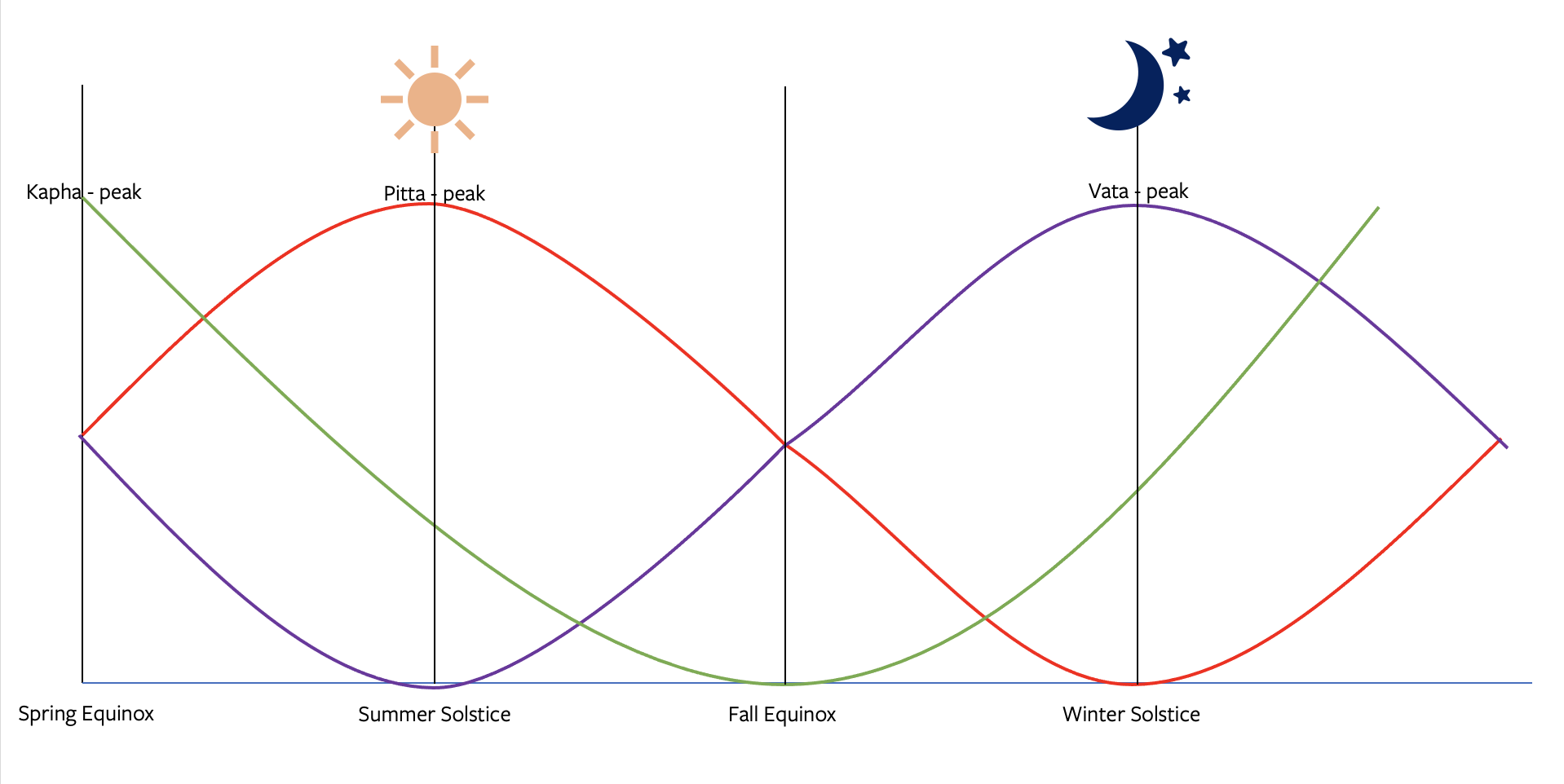
Nature, in all her benevolent wisdom, shares this rhythm with our microcosm. She titrates our exposure to the fire that has been covered in shadow and snow for months, that wakes us up gradually, that demands we pay attention to the volatility (anyone who says vāta isn’t “dominant” doesn’t know its unmatched tenacity) of the macrocosm so we can build the resilience to adapt. The surge of water we experience internally and externally creates a kind of balm to protect us from the growing yang in our midst. While some approaches to “seasonal balance” encourage a drying up of excess moisture through things like pungent flavors, intense/stimulating exercise and breath work, and fasting, I’d gently suggest that adding dryness to the system is *never* the way to go. Dryness = death in traditional systems (thanks again, vāta), and so when the flood tides are rising we’d be better off moving that excess. Opening the channels for water to flow. And guess what? Nature, in all her benevolent wisdom, has just done that for the last twelve-ish weeks. Opening us up in the presence of vāta, imprinting upon us the felt experience of space and movement that will serve us most now.
**
These conditions shed a slightly different light on our understanding of “beginnings,” which is one of the ways we can characterize the spring season overall. In the Āyurvedic cycle of life, spring is the time of kapha doṣa, whose dense, soft, cool, and pleasure-seeking qualities take the form of little babies we can’t help but love. While in many ways babies are blank slates—eager to soak up all the sensory impressions around them—ask any astrologer, genetic specialist, therapist, or 30-something, and they’ll remind you that we come into the world with all kinds of impressions. So, too, are all things new in the world. New jobs, new relationships, new possessions, new homes rarely exist in a vacuum. What’s new about those things and experiences is you—how your presence creates a new relationship, a collision of things that already-were. As my ever-wisening and clearest, unsettling-collision-mirror of a sister recently said to me about a new beginning in my life that caught me off guard, felt like it came out of nowhere: “Everything you’ve been doing for years has resulted in this opportunity, Jennifer. Why are you doubting it?”
Keeping one foot in winter while the other leaps into spring prevents us from feeling overwhelmed by the possibilities, from being burned by the fire before we even get a chance to enjoy the warmth on our skin. The growing already happened—under ground, all winter long. Now, all we have to do is release that potential energy into becoming a self we may not recognize, but perhaps closer to the Self who we can spot by their shadow and by their light, whose laugh we would recognize anywhere.
“As we let our light shine, we unconsciously give other people permission to do the same. As we are liberated from our own fear, our presence actually liberates others.” —Marianne Williamson
To begin is to “open up,” to allow the light that has always been there to be seen again. Spring does not put us at the starting line; it volta-s us from the innermost part of our spiral so we can expand into the space that’s been made for us all winter.
“And the day came when the risk to remain tight in a bud was more painful than the risk it took to blossom.” —Anaïs Nin
**
In the realm of practice, we will honor this moment of turn by reinforcing the lessons from the last two six-week quarter-seasons: orienting to and occupying space through the sense of sound, and being moved by air through the sense of touch. This pairing equates to vāta doṣa, which we won’t necessarily say “good-bye” to as the seasons turn; vāta may not be the dominant doṣa of spring according to the books or quantities, but its ongoing presence both animates kapha and stokes pitta to create the just-right ratio of water and fire to generate life (don’t you just love the poetry of Āyurveda?). Putting vāta into this relationship with kapha and pitta transforms the very nature of this oft-maligned doṣa. With a substrate to move against and through, and a direction to follow, vāta becomes organized; its enthusiasm builds into a rhythm that is joyous rather than anxious. It becomes prāṇa.
Physiologically and energetically, this combination is an exercise in finding our center—aka balance. We’d do well to remember that earth’s axis at this “balance” point is actually still tilted in an absolute sense; it’s just the perspective, the relationship with the sun, that makes it appear centered. Moving between the organic, horizontal, smooth shapes of yin and the angular, vertical, clear, shapes of yang, we’ll find power in all directions so that we can tip into the macro-season of yang with response-ability: the agility and suppleness that arises from the practice of yoga as defined by “skill in action,” as being able to pause, evaluate, and move in a way that preserves life, efficiently and gracefully.
Through the rest of this quarter-season, we’ll turn toward the light by orienting to practices that explore the sense of sight and fire element until Beltane (May 1). We’ll release the potential energy built in the internally rotated standing meditation of ayita (goat pose) into the kinetic energy of externally rotated malāsana (garland pose, or full squat). Supporting coordination along the outer seam of the body, strength in the muscles of the eyes, and a clear line of communication between the feet and psoas, we’ll literally spring into action as soon as the Prāṇa-Master Sun cues us in And once things start to melt (they will?…they will!), our lymphatic drainage/rasa circulating practices (a fan favorite) will be literally at our fingertips.
**
As I was preparing my classes and writing this post for the equinox, I couldn’t help but realize that the “springy” movements I was offering weren’t landing the way I hoped. People weren’t landing—literally; their bodies were wobbly, tired, heavy, sodden with grief. This wasn’t normal kapha, normal “I’m done with winter” fatigue; this was something new, a feeling that, after observing it in others, I more fully recognized in myself, too. We’re living in interesting times—black, white, and red times, lacking the other colors of our prism of spring to animate or inspire. We cannot and should not force enthusiasm just because we’ve reached line twelve in our sonnet and it’s time for the volta. Instead, we can allow the volta of our time to accurately resonate the what’s at heart of our poem—the True Nature of the Seer, the intention of the poet. We might not yet have a word for the shade of blue we are feeling, but we might find some solace, even delight, when we open our eyes to recognizing it, and being recognized by it, because we’ve allowed that wavelength of our own prismatic Self to shine .
“A golden disc covers the face of the truth. Oh Sun, remove that lid for the sight of this seeker of Truth.” —Ishavasya Upanishad, 15/15